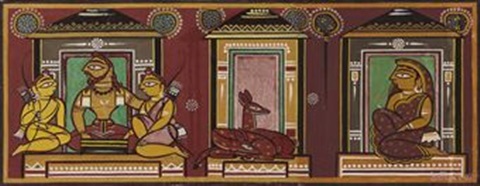
Manish Bajaj knew enough about art to be a successful dealer and enough about human nature to make an occasional killing. He was all of forty six years. His parents had travelled to this city, seventy years back from Isali in Marwar of Rajasthan. Manish found something which not many at the time did, after passing his graduation from Goenka College of Commerce. Bengal was a heritage in art and works of Binode Bihari, Ram Kinkar, Nandalal, Jamini Roy, Gagendranath, Ganesh Pyne, Bikash Bhattacharya was much in demand. He studied the market and very soon opened an art gallery while dealing in this trade. For a person with his aggression, tact and foresight, the sky was the limit, and in no time, he had become one of the biggest art dealers of Calcutta with linkages to the auction houses and galleries spread across the world. Business had been quiet all week at his Durga 99 gallery on Shakespeare Sarani. Plenty of people had stopped to stare at the pictures on display in the window and a few had ventured into the shop to browse, but there was only one sale to record. It was depressing. When the stunningly beautiful woman appeared, however, he sensed that his luck was about to change. A disappointing week might yet be redeemed. She was dressed in old black, a simple body hugging tee with the contours of her breasts clearly showing off and a stone-washed black jeans with a cheap high heel.
“Good afternoon,” he said with a polite smile.
“Oh, good afternoon,” she replied nervously. “ Are you the gallery owner ? I called up on the number given on your website and the person told me to come at this time. ”
“Yes. Manish Bajaj.Ah, then you must be Miss Das.” He could not resist but extend his hand to get a touch of her.
“That’s right. Rituparna Das.” She merely brushed his palm with her fingers.
“ Your gallery is such a long walk from the metro.”
“I assumed that you’d come by taxi.”
“Taxis are far too expensive. I stay in Ahiritola.”
The remark confirmed his first impression of her as a woman of rather modest means. Rituparna was smartly dressed but her clothes had the faded look of garments worn far too often over far too long a period. Her hair was cut short but she was no doubt attractive even in her attire. Manish placed her age at mid thirties. Her voice suggested culture and she bore herself well. There was a faint smell of a modest perfume and underneath that Manish detected the scent of genteel poverty. He is aware of this selective population of Calcutta, a gradually decaying one which is holding on to the last remnants of their vestige.
“You’ve brought the painting, I see,” he observed.
“Yes,” she said with a wan smile. “Do you mind if I sit down for a moment? Carrying this has rather tired me out.”
“Of course, Madam.” He held the back of the chair as she gratefully lowered herself down. Manish ogled at her cleavage as she sat down. The black bra straps were clearly visible. “Take your time,” he said.
“Thank you.”
“Wait till you get your breath back.”
“I hadn’t realised that it was so heavy. And its so hot and humid.”
“Art has its own tonnage. And you can’t change the climate of this city.” Manish gave a brittle laugh. As he subjected his visitor to a more searching gaze, he stroked his chin. Rituparna Das was clearly not accustomed to art galleries. She was looking around with the wide-eyed curiosity of a child on her first trip to the zoo.
“What a lot of paintings you have!” she said.
“I like to keep a large stock.”
“Most of them seem to be portraits.”
“My specialty.”
“Why are there are no prices on them?”
“Price tags are rather tacky, I always think,” he said airily. “This is a temple of art, not a supermarket. I sell quality, Miss Das, and it is not always easy to set a price on that. Everything you see here has only an approximate value. This allows for negotiation or, to use another word, haggling. The true price of a painting is the amount someone is prepared to pay for it. That’s what makes the world of art so fascinating.”
“Is that so?”
“Yes, Miss Das. That, and the fact that you never know who’s going to walk through the door next. When you least expect it, a missing gem might turn up out of the blue.” He glanced meaningfully at the painting that she held across her lap. Wrapped in brown paper, it was secured with white string tied in an elaborate bow. She ran a proprietary hand around the edge of the frame as if reluctant to part with the object. Manish prompted, “Over the telephone, you mentioned Jamini Roy.”
“That’s right, Mr. Bajaj. Jamini Roy. You know he made 17 canvases on Ramayana. This entire work is there at Rosogolla Bhavan. But he also made a 18th one for Sarada Charan Das, who was the patron for this series. That’s a portrait of Valmiki. ”
“ I have seen those works. Fascinating and intriguing series. But Jamini Roy gave up portrait painting in 1920s.”
“My father always said that.”
“ Your father ?”
“ Yes, Badal Das” she explained. “The painting used to belong to him.”
“Used to?” he probed.
She nodded sadly. “ Father died last year. He left everything to Paoli and me. Paoli is my younger sister. We live together.” She heaved a sigh. “Not that there was much to leave, I fear. Father had a diary and used to supply milk to K.C.Das from the time of Sarada Charan Das. Sarada Charan and him were friends, though father was much junior to him. Almost two decades back there was a mad-cow disease and his dairy got wiped out. He was not a wealthy man. But he did know what he liked when it came to art. He was gifted this work forty years ago by Sarada Charan for helping out on a calamity which touched the entrepreneur’s personal life. My father refused to part with it, even when times were hard. According to what my father told me a couple of years back, its value is Rs. 20 Lakhs now.”
“At least, Miss Das. If it’s genuine.”
“No question of that. I have my father’s word.”
“Was he an art expert?”
“No, Mr. Bajaj. I told you the business he was in. But he knew about art.”
“The painting was gifted, you say?”
“Yes,” she confirmed, resting it against the chair so that she could rummage in her purse. “I even have the gift certificate and the original scribble of Jamini Roy to Sarada Charan Das somewhere. Father never threw anything away. Businessmen know the importance of receipts.”
“Quite so.”
“I’m sure it’s here somewhere.”
“While you’re searching for it, do you think I might take a look at the painting itself? I’m something of an authority on Bengal Art. It won’t take me long to authenticate it.”
“I found it,” she said, producing a scrap of paper and handing it over.
“I know the life of Sarada Charan Das and his multi-talented personality. In those days Bengali businessmen were a class apart” he said, looking at the paper before returning it to her. I have four Jamini Roy in my stock. May I see if the painting ? ”
Rituparna Das hesitated. Needing to sell the painting, she was somehow loathe to part with it. Manish tried to contain his impatience, deciding that she must have a sentimental attachment to the heirloom-which would make it more difficult for him to prise it away from her. Finally, taking a deep breath, she picked up the painting and handed it over, wincing slightly as she did so. Manish lay it on the table and undid the string. He removed the brown paper with great care, then gazed down with admiration at a stunning Jamini Roy.
“It reflects the true essence of Bengali folk art . The Bankura touch and the santhal influence is also visible, Mr. Bajaj.”
“I know that, Miss Das.”
The painting was genuine. Manish Bajaj needed little time to establish that. The unmistakable Kalighat patua style with natural colours, using earth, chalk powder and vegetable colours. The dealer feasted his eyes for several minutes. Then he became aware that Miss Das was standing at his shoulder.
“Well?” she said, hopefully.
He shook his head. “It’s a clever fake,” he announced.
“It can’t be!”
“It is, Miss Das”
“But Jamini Roy’s signature is there. You also saw the letter of Sarada Charan to my father mentioning this gift.”
“I’ve no doubt that your father took it in good faith,” he said, turning to see her stricken face. “This painting would fool most people. There are one or two tiny clues that prove it is not an authentic Jamini Roy, but I won’t bore you with the details, Miss Das. Thank you so much for showing it to me,” he said as he started to wrap it up again, “however, I’m afraid that I can’t make an offer for it.”
“Oh my God !”
“Great pity. I had high hopes.”
“ Father swore that it was genuine.”
“It’s an ingenious copy, Miss Das. Nothing more.”
She was appalled. “Does that mean it’s worthless?”
“Not necessarily,” he said, tying the string once more. “There are some dealers who might be interested. I can recommend one, if you like. He’d only be able to give you a fraction of what a real Jamini Roy would fetch, but it would be something.”
Rituparna Das was crestfallen. She went back to the chair and sank down into it with a glazed expression on her face. She looked hurt and betrayed. Manish Bajaj manufactured a sympathetic smile. He took a card from his wallet and offered it to her.
“Try this guy on Kyd Street,” he suggested. “You might have some luck.”
Vijay Khemka described himself as an antique dealer, but his collection consisted mainly of reproduction furniture, half-hidden beneath an amiable clutter of Burmese wooden furniture, Belgium porcelain mugs, chinaware, wind-up gramophones, vintage tele-phones, Remington typewriters, old postcards, assorted paintings, and general bric-a-brac. When his mobile rang, he had to move a pile of dusty old dailies in order to get at the instrument.
“ Khemka Antiques,” he said, removing the cigarette from his mouth. “Can I help you?”
“ Vijay? It’s Manish. Can I talk confidentially ? ”
“There’s nobody here, if that’s what you mean.”
“Good,” said Manish on the other end of the line. “I want to send some business your way.”
“Sounds promising.”
“It’s more than that, my friend.”
Vijay replaced the cigarette and listened intently. Manish Bajaj operated much further up the social scale than he did, but they had been partners in more than one lucrative deal. Vijay Khemka was a small, fat, rather grubby man in a crumpled shirt with an oily face. His eyes sparkled with interest as he listened. He was soon sniggering.
“Are you sure it’s a genuine what’s-his-name?”
“ Jamini Roy,” said the voice. “No doubt about it.”
“How much should I offer the lady?”
“Try her with twenty five thousand. But be prepared to go up to fifty thousand”
“ Half a lakh!” exclaimed Vijay.
“ It’s worth over forty times that, Vijay, believe me. Bring this one off and you’ll not only get your own money back but with your usual percentage of the sale price you can expect a hefty sum. We’ve hit the jackpot this time.”
“Send her in you car !”
“ Don’t worry. She will come. Fallen on bad times and parting with this gem. You know how Bengalis live off their family heritage and don’t have the urge to do any hard work. But she is good looking. Middle age. Seems unmarried. The painting belonged to her father when she got it last year after her father’s demise. Miss Rituparna Das will be there any minute. I took pity on her and booked her an Ola from my mobile.”
“ Manish Bajaj taking pity on someone?” said Vijay with a harsh laugh. “That’ll be the day. You’d swindle your own brother, if required.”
“I can do without the sarcastic comments,” chided Manish. “I’ve just cut you in on a juicy deal. A little gratitude would not be amiss.”
“I know. Thanks.”
“We’re in this together, remember. All three of us.”
“Three of us?”
“You, me, and Jamini Roy.”
The line went dead and Vijay kept back the mobile on his table. Crossing to a large gilt-framed mirror on the wall, he smartened himself, then took out a comb to slick his hair into a semblance of order. He did not have long to wait. A few minutes later he saw the cab pull up outside. Dropping his cigarette to the floor, he ground it out with his heel, then pretended to examine the engraving of an ornate mirror. Vijay looked up and saw the curvaceous figure of Rituparna Das coming towards him. He gave her an oily smile of welcome.
“Can I help you, madam?” he cooed.
“I hope so. Mr. Khemka, is it?”
“That’s right. Vijay Khemka, at your service.”
“Mr. Bajaj sent me here.”
“ Manish Bajaj ?”
“Yes. Such a considerate man.”
“And one of the finest art dealers in Kolkata. Manish really knows his stuff. He’s a true specialist. Whereas, I,” he confessed with a glance around the room, “have more general interests.” He put the mirror aside. “Do you have something to sell? Is that why he sent you?”
“It’s rather a long story,” she sighed.
“Then at least be comfortable while you tell it.”
Vijay moved a Shantiniketan dari from a bentwood arm-chair. Miss Das sat down and launched into her tale of woe. Although he had already been given a shortened version of it, Vijay Khemka listened carefully and nodded encouragingly. He exuded sympathy throughout.
“What a letdown!” he concluded. “You think you have something of real value and it turns out to be a fake. Great shame! But it’s an all too familiar story, I can tell you. There are lots of unscrupulous dealers around unloading bogus paintings and antiques.”
“But my father was given the painting by a very respectable businessman.”
“So you said. Sarada Charan Das.”
“ Of the famed K.C.Das family. I even have brought my father’s will. Just to prove that the painting is legally mine. Well, the joint property of my sister, Paoli, and I, to be more exact. I don’t expect you to take me on trust. I want everything to be open and transparent.”
“If it were a genuine Jamini Roy, I’d need to see your documents in order to establish provenance. That’s the origin of the painting. How it came to be in your possession. In this case, since it’s not the real thing, we can forget about the niceties. All I need is a sighting of it.”
“Of course.”
“ Well in my trade, one man’s trash is another’s treasure. But I can value everything and give a fair price for it. You see nothing is worthless.”
“I suppose so.”
Miss Das handed over the painting with a mixture of sadness and apprehension, sorry to part with it, yet fearing it would be rejected. She was patently shaken by her setback in the Durga gallery at Shakespeare Sarani. When she gazed around her, she was not reassured by what she could see. The place was a mess. A distant smell of termites troubled her. Vijay Khemka had none of the class evinced by Manish Bajaj. Clearly, she had come several steps down the food chain.
Vijay Khemka unwrapped the painting and propped it on a sideboard so that he could scrutinize it. He mumbled quietly to himself.
“ Valmiki,” she said, proudly.
“That’s the Ramayana writer who was a dacoit ?”
“Yes. ”
“It’s good,” he said at length. “I have to admit that. It’s very good. First-rate, in fact. It may not be an authentic Jamini Roy, but it’s the next best thing. Only an expert like Manish Bajaj would know the difference.”
“Does that mean you’ll buy it?”
“Possibly. That depends on the price.” He turned to face her and tried to sound casual. “What sort of figure did you have in mind?”
“I don’t really know.”
“You must have some idea.”
“ Father always said the value would run into twenty lakhs, if not more. But now . . .” She gave a hopeless shrug. “I haven’t a clue.”
“Would twenty five thousand tempt you?”
Miss Das recoiled. “Is that all?”
“Let’s make it thirty thousand, shall we?”
“I was expecting a lot more than that, Mr. Khemka,” she said, getting to her feet. “Paoli and I manage on our meagre salaries as teachers and the little we’ve put aside. We have no other source of income. Both of us have not married. But we have the family house to maintain and its fairly large. We were thinking of renovating a part of it and put it on rent, To be honest, that’s the only reason we’re willing to sell the painting. We need the money. It’s as simple as that.”
“ Forty ,” he offered.
“ Paoli will be horrified. My father’s soul will be cringing in agony.”
“So would Jamini Roy,” he argued, “if he knew that someone was turning out fake copies of his work. Artists have their integrity.” He took out his chequebook. “Forty thousand. Not a paisa more.”
“Then we’re wasting each other’s time,” she said with sudden determination, crossing to wrap up the painting again. “I’m sorry to have troubled you, Mr. Khemka. But I think I’ll try elsewhere.”
“You won’t get a better deal. I promise you.”
“We’ll see.”
“Most dealers wouldn’t touch a fake like that.”
“Stop calling it a fake,” she protested. “It’s embarrassing.”
“Forty five.”
“Can’t you go any higher than that?”
“I’m already into philanthropy! Ok, Fifty thousand or nothing. Most Godmen are thugs and that’s the theme now. Valmiki was a thug converted to a Godman. I like the paradox compared with the modern Babas and hence giving a premium. ”
She paused. “Is that really all it’s worth?” she murmured.
There was such a look of despair in her eyes that Vijay softened. His eyes had been feasting on the naked skin of Rituparna. He also remembered Manish Bajaj’s estimate of the true value of the painting. If he allowed it to slip through his hands, he would get no more lucrative commissions from Manish. Besides, if his visitor took the painting to an honest dealer, it might be recognised for what it was and then she would suspect collusion between Vijay and Manish. In this city there are still a lot of genuine art collectors and they understand the true worth of a painting. There could be awkward repercussions. The antique dealer was in a real quandary. Miss Das was starting to re-tie the string when his hand stopped hers. “Sixty thousand rupees,” he blurted out. “Take it or leave it.”
“ Ok. But in cash,” she silently said.
Manish Bajaj was delighted by the turn of events. As he locked up his gallery for the day, he congratulated himself on his stage management. Thanks to his guile, he had acquired a painting for less than a twentieth of its real value. Even allowing for Vijay Khemka’s percentage, he would make a sizeable profit. He has a ready NRI banker in UK who collects Bengal Art of mid 1900. Not that he would rush to part with Jamini Roy’s painting . It would join his own treasured collection at Durga 99 and he will also showcase it in the Art Fair at Delhi in next Feb to get contacts of some new collectors. A new Jamini Roy is unheard of in the last four decades. There is a painting of Lav and Kush with Valmiki of Jamini Roy, but none knows that the artist had done only Valmiki also. Probably during the series, Roy had made this and then gifted to his friend and benefactor. Art was not commercialized during those times.
The rush hour delayed his Mercedes, but he eventually drew up outside Khemka’s Antiques on the narrow Kyd Street. He peered in through the window and saw his friend pulling on a reflective cigarette as he appraised his latest purchase. Manish let himself into the shop.
“You got it, then?” he said with a complacent smile.
“Eventually,” replied Vijay.
“What do you mean?”
“ The dame wouldn’t let it go for less than sixty thousand.”
“ Sixty Thousand? I told you to stick to fifty.”
“You wanted the thing, didn’t you?”
“Yes, but at a maximum profit.”
“What’s another ten thousand to you, Manish ? She needed the money. You don’t. Poor thing had her heart set on getting a lot more. A house to be renovated for her and her sister. With her beauty she can do some many things for being successful, but you know how middle class Bengalis are.”
“I do,” said Manish irritably. “And now we do have it. Valmiki by Jamini Roy. One of the greatest that the earth has produced. ”
“Why? Was he a Tagore ?”
“No, you idiot! He was one of the greatest pupil of Tagore himself. He shunned the western style and became famous. Is considered among the top twenty artists of 1900. Was given the Padma Bhushan. How on earth do you make a living at this game when you know so little about art?”
“I know more than the commoners who come in here.”
“Like Miss Das.”
“A lamb to the slaughter.”
“Rather a sweet lamb, I think, but there’s no room for sentiment in this business. Now then, give it here,” he said, lifting the painting up. “Let me gloat.”
Manish Bajaj chuckled quietly as he studied the painting. It had all of Jamini Roy’s distinctive hallmarks. Vijay looked over his shoulder, beaming vacuously. The mood of contentment soon passed. Manish tensed, twitched violently, then spluttered with rage.
“You paid sixty thousand for this!” he yelled.
“Yes, Manish.”
“You fool! You idiot!”
“What are you on about?”
“This painting. It’s a fake.”
“But you told me that it was genuine.”
“It was when I examined it at my gallery. I was absolutely certain.”
“Then you must have made a mistake.”
“I never make mistakes.”
“Then how come this is a dud?”
Manish Bajaj needed only a few seconds to work it out. “We’ve been duped, Vijay,” he growled. “She beat us at our own game. She must have switched the paintings on her way here. The cunning devil with a body hugging top and her sad story ! Miss Rituparna Das was no lamb to the slaughter. She pulled the wool over our eyes good and proper. God knows what her real name is. ”
Kharaj was still at his easel when she got back. He heard Ritu singing happily to herself as she let herself in. It was a good omen. He reached for a cloth to wipe the end of his brush. She swept in with a painting under her arm-wrapped in brown paper and tied with white string. There was a real spring in her step. Kharaj went over to give her a kiss.
“How much did you get this time?” he asked.
“ Sixty thousand.”
“Not bad for a week’s work.”
“It took you longer than a week to paint the fake,” she reminded him. “But you’re the real hero, Kharaj.”
“What was I today?”
“My dead father.”
“That makes a change. Last time I was your dying brother.”
“You’re neither brother nor father,” she said fondly. “You’re my lover. My partner in every sense.” She took off her top and walked up to him to gently kiss him on his lips.
Kharaj and she had been doing this ever since he had passed out of the Government Art college, two decades back. On and off. It funds their luxuries and vacations. And sometimes they buy originals. Last month she had sold a Lalu Prasad Shaw in Delhi.
“You should have been an actor, my love,” he said.
“I am. But I don’t want a minor part in a movie. I am the part of my life’s story. Where’s the champagne?”
“On ice.”
“How long will you be?”
“I’ve just finished,” he said, pointing to the easel. “It’s Man with the Flower Pot by Dharmanarayan Dasgupta. My tenth version. By now, I can practically turn them out with my eyes closed. They get better each time. With Section 377 abolished, this theme will rise in value.”
“So do I believe,” she boasted with a laugh. “Fetch the bottle.”
“Where are we going to celebrate?”
“Where else? Come on and sit on my lap. I feel horny after doing busines” She kissed him again on the lips and opened her bra.
Kharaj backed away and pretended to be shocked to look at her topless torso. “ Would you kiss your father like that ?”
“My dead father,” she corrected, “which is probably even worse. But the person I really want to share this triumph with is Jamini Roy.”

