Ramkinkar’s art was fearless, unapologetic. He was mentored in Shantiniketan by Nandalal Bose and Rabindranath Tagore. Born on 26 May, 1906 in Bengal’s Bankura district, he was spotted by journalist Ramananda Chatterjee and inducted in Santiniketan in 1925. After seeing his first environmental sculpture in cement-concrete, Sujata, in 1935, Tagore reportedly said that he be allowed to sculpt as he wanted them across the campus.
A kurta frayed at the edges, Chinese straw hat on his grey curls, fingers gliding impatiently over a sheet of paper in his hands, lost in his own zone, Kinkarda was a familiar figure in the campus.
Never one to care about others’ opinions, fame, or money, Baij’s being was all about his art. From sculptures to oil paintings, portraits to miniatures, the artist could master any medium with unfathomable ease.
While his entire body of work is foundational to modern Indian sculpture, ‘Santhal Family’ (1938) and ‘Mill Call’ (1956) stand out as specifically telling of the man himself.
“He would often look at the work of his contemporaries and say, ‘They all look like statues. How long will they stand still? Why aren’t they moving?’ For him, his work, much like his life, was all about movement,” renowned sculptor and Baij’s protégé KS Radhakrishnan explained. For Kinkarda, inspiration was hidden in everyday life — in the tunes of a Bhatiali song, in the lilt of the flowing Khoai river, in the rustle of fallen leaves.
Baij’s complete disregard for validation didn’t fare too well with authorities. In 1979, his Tagore bust in Balatonfüred, Hungary, was in the eye of a political storm, when a Bengal minister, Jatin Chakraborty, threatened to have it uninstalled on the grounds that the inward looking, armless bust “barely resembled” the icon. (In 2017, BJP leader Siddhartha Bhattacharya raised similar allegations against Baij’s sculpture of Mahatma Gandhi in Guwahati.)
Baij dismissed the Tagore bust controversy — which occurred mere months before he breathed his last — by saying, “Let them destroy it. Who cares? I never asked them to install it.”
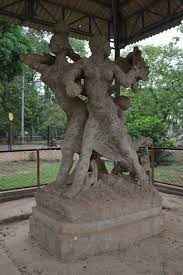
‘Mill Call’, 1956. Image credit: Wikimedia Commons
Baij’s famous ‘Buffalo/Fish’ sculpture at Shantiniketan’s Birla Girls’ Hostel has an equally irreverent origin story: When the commissioning authorities expressed reservations over the sexually evocative figures of water nymphs being installed in a place of study, the artist changed the tiles of his sculpture to resemble a buffalo with a fish-tail splashing water (bearing an obvious sexual connotation) — a sly dig at his would-be censors.
‘Buffalo-fish’ sculpture in front of the Birla Girls’ Hostel in Shantiniketan. Image credit: Facebook/ramkinkarbaij
His art was incendiary, like art is meant to be.
Baij forced the Indian eye to appreciate beauty beyond the British aesthetics of anatomical realism. He sculpted with concrete and pebbles, discarding unaffordable plaster of Paris, and moulded them with armature. The artist painted on bedsheets too, as canvases were mostly beyond his means.
“Whatever little money I get from my pension, I use that to buy food. I hang my oil paintings upside-down from the roof to stop the rain from leaking into the house. It’s oil, so the water won’t damage them,” Baij once explained to Ritwik Ghatak on camera, as he nonchalantly slided one of his paintings under the roof to stop a drip during the interview.
‘Summer noon’, oil on gunny cloth. Image credit: Facebook/ramkinkarbaij
When Prime Minister Jawaharlal Nehru commissioned Baij to sculpt the Hindu mythological figures of Yaksha and Yakshi (which now stand guard at the gates of the Reserve Bank of India in the capital), the artist decided to carve them out of sandstone found in Himachal’s Kullu Valley.
After three rounds of generous monetary grants that were spent solely on transporting the stone to Delhi via special train wagons, Baij was barely convinced with the piece. It was only on the advice of Rajkumar Jaitley, a former student, that Baij decided to finally end the project.
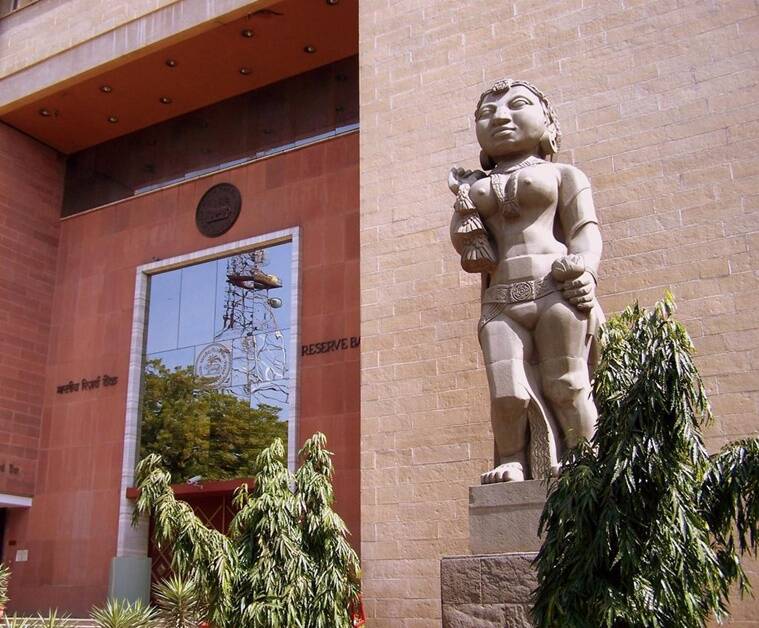
‘Yakshi’ stands guard in front of the Reserve Bank of India in Delhi. Image credit: Facebook/ramkinkarbaij
The non-conformist indeed believed in the existence of limitless possibilities. He experimented with medium and subjects alike, from evocative and spontaneous watercolours, to producing arguably India’s first abstract outdoor sculpture, Lamp Stand. For oil paintings, he would replace expensive canvases with bedsheets and gunny cloths and thinned local packet colours with linseed oil. If there were no iron rods to create a frame for sculptures, he would turn to the humble bamboo sticks.
The artist shared a deep relationship with the communities around him, who were his protagonists as well as audience. His students recall how when their teacher “Kinkar da” presented plays of William Shakespeare in the Kala Bhavan campus, the local Santhal villagers would be seated before in rapt attention.
Baij stood out in the crowd — he thwarted the rules flamboyantly, but only after he had quietly mastered them.


